SpaceX Flies Starfall, Its Secretive Orbital Cargo Capsule
A disc-shaped capsule built to bring cargo back from orbit could open a new business for SpaceX: making things in space and landing them on Earth.
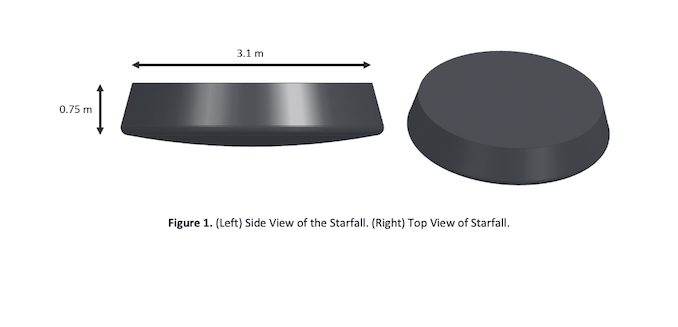
SpaceX put a new kind of spacecraft into the sky from Cape Canaveral early Tuesday, and it has been conspicuously quiet about what the thing is for.
The flight, a demonstration mission named Starfall, lifted off on a Falcon 9 from Space Launch Complex 40 with a window opening at 6:43 a.m. EDT. Starfall is an uncrewed reentry capsule, a disc-shaped vehicle SpaceX wants to use for two jobs that read like science fiction until you reach the regulatory paperwork: making products in orbit, and delivering cargo from one point on Earth to another by way of space.
The hardware itself is small. According to an environmental assessment the Federal Aviation Administration published in May, each capsule stands about 0.75 metres tall and 3.1 metres across, weighs roughly 2,100 kilograms empty, and can carry up to 1,000 kilograms of payload, for a total mass near 3,100 kilograms. There is no main engine. An attitude-control system that puffs inert gas can point the capsule but cannot push it out of orbit, so Starfall comes home when its path brings it home, not on command.
How it is supposed to work
The capsule is built from two main pieces, an aluminium top plate and a carbon-fibre heat shield. After reentry the top plate peels away to release a parachute stack, a drogue, a pilot and a main canopy, and the capsule splashes down for recovery in the Pacific, the way Dragon is retrieved. SpaceX has not said how many capsules are aboard this demo, how long they will stay up, or whether any customer cargo is along for the ride. Almost everything known about the vehicle has come from the FAA filing rather than the company.
What the paperwork describes is ambition. The stated purpose is to "enable point-to-point delivery of critical cargo through space on rapid timelines" and to "create a self-sustaining commercial in-space manufacturing market," selling time in microgravity and a safe return "as a service at scale." One passage floats Starfall as a possible "proliferated successor to the International Space Station," scaling the station's manufacturing experiments into an industry. The pull is real: in microgravity, some crystals and drug compounds form with a purity gravity makes impossible on the ground, which is why SpaceX would be chasing the same customers as Varda Space Industries, the startup already flying small manufacturing capsules home.
The rocket underneath was the routine part. Falcon 9 booster B1078 was flying for a 29th time and aimed to land on the droneship A Shortfall of Gravitas in the Atlantic, which would be the program's 628th booster recovery. Forecasters gave a 95 percent chance of acceptable weather.
Strip away the secrecy and the interesting part is not the capsule but the economics around it. A cheap, repeatable way down from orbit is the missing half of any plan to manufacture in space and sell on the ground, and SpaceX already owns the way up. The same week it shipped NASA's Roman Space Telescope toward its launch site, the company was quietly testing whether orbit can be turned into a return address.