Why Some Books Have Two Different ISBN Numbers
A book carrying two ISBNs usually isn't a printing error. It's either a leftover from the industry's 2007 switch to 13 digits, or separate codes for separate formats.
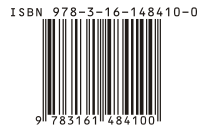
Flip to the copyright page of an older paperback and a newer reissue of the same title, and sometimes two entirely different strings of digits both call themselves the ISBN. Neither is a typo. Both are real, and they trace back to two separate causes that have nothing to do with each other.
The first cause is a global format change that wrapped up nearly two decades ago. Until January 1, 2007, every International Standard Book Number ran ten digits long. By the mid-2000s, the pool of available 10-digit combinations was thinning out fast enough that, according to a transition notice Penguin Random House sent its retail and library partners in 2005, "the international ISBN agency expects to run out of some available 10-digit ranges as early as mid-2007."
The fix was ISO 2108:2005, the fourth edition of the ISBN standard, published that October. It didn't just add digits — it merged the ISBN with a numbering system retailers already used at the register.
Riding along with the barcode
The 13-digit ISBN is identical to the EAN-13 barcode already printed on a book's back cover. Publishers gained a three-digit prefix, almost always 978 (979 was added later as 978 filled up), assigned to books under a fictitious country code the industry nicknamed "Bookland." ISO's own account of the change describes it as necessary because "the very success of the ISBN system, up to now based on 10 digits, has been causing it to run out of capacity."
Publishers didn't flip a switch overnight. Penguin Random House's internal timeline shows a two-year dual-numbering period, 2005 through 2006, during which both the 10- and 13-digit forms worked side by side. The publisher scheduled its own system conversion for Presidents' Day weekend, February 18–20, 2006 — three quiet days chosen because almost nobody orders books over a long weekend. Any book with an official on-sale date after January 1, 2007 got only the new number. Anything printed earlier kept its original 10-digit ISBN in circulation indefinitely, which is why secondhand shelves still turn up plenty of them.
The second, unrelated reason
Format, not vintage, explains the rest of the mismatched-ISBN cases. A hardcover, a paperback, an ebook, and an audiobook of the same novel are treated as different products in the supply chain, and each needs its own identifier. ISBN Services, a self-publishing assignment agency, walks authors through the logic: without separate numbers, "retailers may have difficulty distinguishing between the two formats, leading to potential lost sales opportunities." A bookstore's point-of-sale system, a library catalog, and an ebook storefront all key off that number to track which exact version sold, restock, or get shelved.
That's a permanent feature of how publishing works, not a one-time historical fix like the 2007 changeover. Every future edition, translation, or audiobook narration keeps generating fresh ISBNs, format by format, long after anyone remembers there used to be a 10-digit version at all.
Self-published ebooks complicate the picture further. Retail platforms that sell ebooks exclusively through their own store sometimes assign their own internal identification number instead of a real ISBN, and that number only works inside that one catalog. Authors who want their ebook to also appear in library systems, other retailers, or bibliographic databases still need to buy or claim an actual ISBN for it — one more way a single title can end up wearing multiple numbers depending on where you're standing.
None of this touches the barcode's cousin, the two speeds pressed into a vinyl record, or the sales-tracking puzzle behind why CDs and vinyl are suddenly swapping places on the sales charts — different corners of the same industry, each solving its own version of "how do we know exactly which product this is." Old paperbacks with a single 10-digit ISBN aren't going anywhere; they're grandfathered in for good. What's actually rare is a book printed after 2007 that still carries only ten digits — track one down and it's likely either an error or a very small press that never updated its systems.