Atlantic 'Cold Blob' Traced to a Weakening AMOC in New Ocean Analysis
A patch of ocean south of Greenland keeps cooling while the planet warms. New observational work says the explanation runs deep, and so do the stakes.
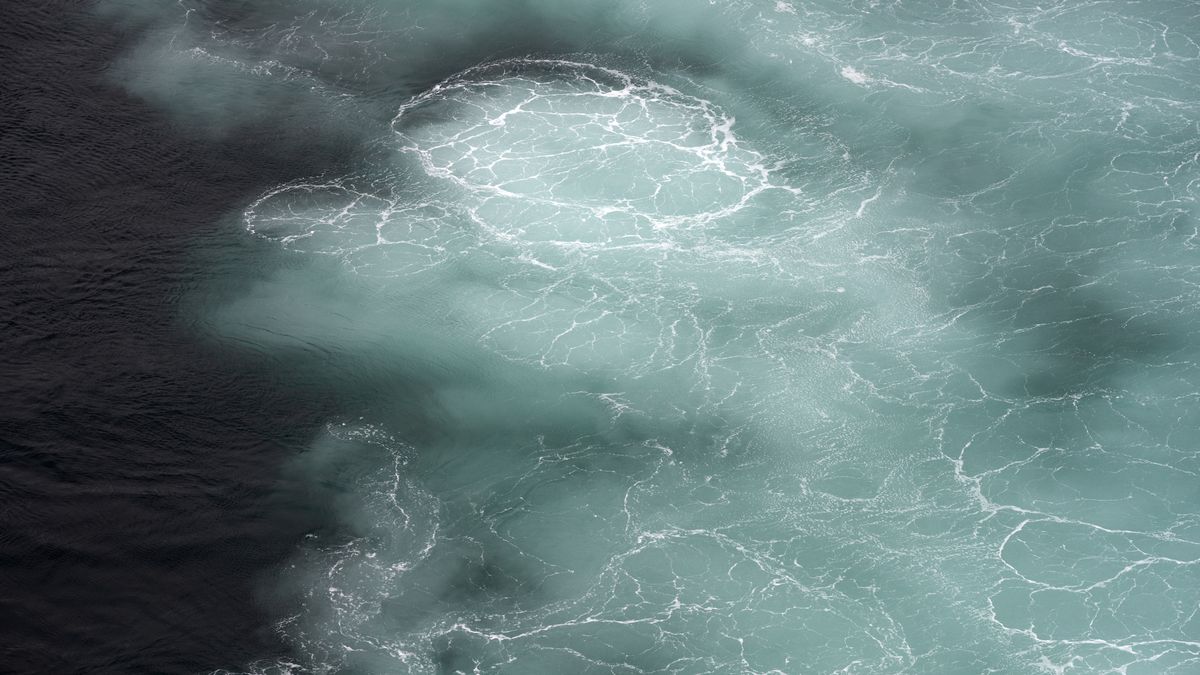
South of Greenland sits a patch of the North Atlantic that keeps refusing to warm. While the ocean almost everywhere else has absorbed heat decade after decade, this one region has cooled, an anomaly strange enough that scientists mostly just call it the cold blob.
A new analysis argues the blob is not a quirk but a symptom. The study, published May 28 in the journal Geophysical Research Letters by an international team of researchers, concludes that the region is cooling because the Atlantic Meridional Overturning Circulation, or AMOC, is weakening and delivering less warm water northward from the tropics. The evidence comes from observational records reaching back to 1955.
Less heat arriving, not more escaping
For years, two explanations competed. Either ocean currents were carrying less heat into the region, or the region was losing more heat through its surface to the atmosphere. The new work weighs the two against each other using satellite data, reanalysis records built on direct weather observations, and ocean heat content measurements spanning seven decades.
The verdict favors the first account. Surface heat loss in the area has actually decreased, the study finds, and the cooling shows up deep in the water column, where winds and clouds have little influence. The observed cooling trend cannot be explained by surface heat flux changes,
the authors write. Heat content swings over decades, they add, track ocean heat transport far more tightly than surface flux variability.
Geography makes the mechanism intuitive. The cold blob, formally known as the North Atlantic Warming Hole, sits at the top of the AMOC's conveyor belt, the current system that hauls warm water, nutrients and absorbed carbon dioxide northward from the tropics and keeps European winters comparatively mild. As the circulation weakens, less tropical warmth reaches the far North Atlantic, and the patch cools. A 2025 modeling study in Communications Earth & Environment reached the same conclusion from the opposite direction, using climate simulations rather than historical observations.
"Given the well-established existence of a tipping point of the AMOC, as well as recent studies finding a range of different 'early warning signals' of the ocean circulation approaching such a tipping point, the strong evidence for a weakening AMOC is a serious concern for society and policy."
From the study in Geophysical Research Letters
How close is the threshold?
The honest answer: nobody knows precisely. The AMOC has been directly monitored only since 2004, too short a record to pin down the long-term trajectory of its weakening, and research into both the blob and the circulation is ongoing. One recent study projects the circulation slowing by around 50% by 2100. The new paper notes that standard CMIP6 climate simulations of future warming cross the AMOC's tipping point in a substantial subset of model runs around the middle of this century, while stressing that large uncertainty remains over how close that point is.
The scenarios behind the concern are concrete, and they cut in unexpected directions. If the circulation shut down entirely, model-based estimates suggest temperatures in parts of the Northern Hemisphere could fall by 10 to 15°C (18 to 27°F), southern Europe could face extreme drought, and sea levels would rise along the northeastern coast of North America. Those are collapse scenarios rather than near-term forecasts; the study's warning is about the direction of travel, not an arrival date.
Tracking that direction is about to get harder. The Trump administration plans to remove 900 deep-sea monitoring instruments from the Atlantic and Pacific oceans, including sensors that would have kept watch on the AMOC.
The authors close on the policy desk's doorstep, writing that the risk requires urgent attention by policymakers.
The next data point arrives the way all of them have: one measurement at a time, from an ocean that is still being watched, for now.